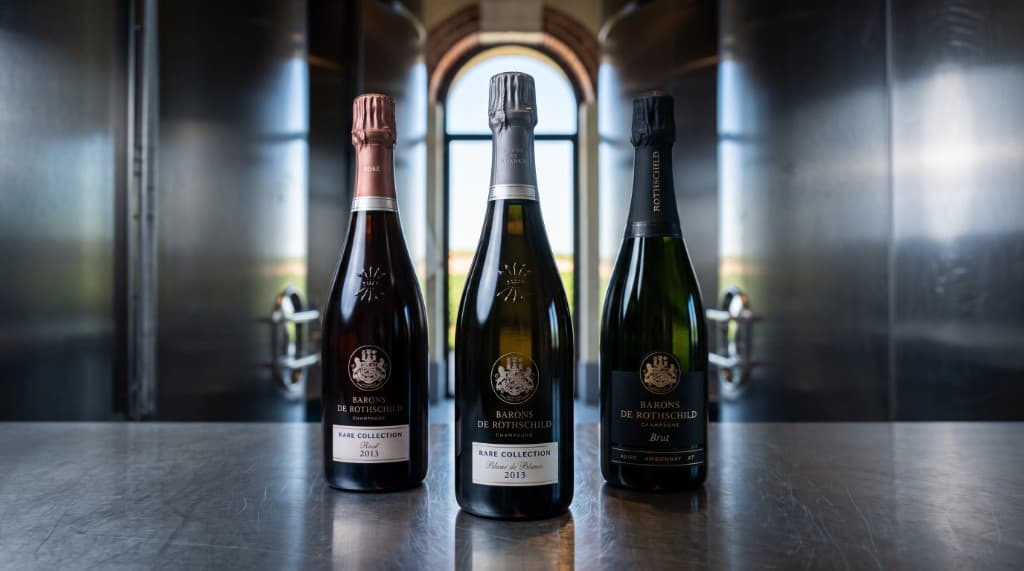
Champagne Barons de Rothschild: twenty years to prove a name doesn’t make the wine
In 2005, the three branches of the Rothschild family joined forces to make their own champagne. The trade saw a marketing play. Twenty years on, the range tells a different story: Côte des Blancs, low dosage, single-plot cuvées and perpetual reserve.
When three branches of the Rothschild family announced in 2005 that they would make champagne, the trade’s reaction was predictable. A famous name, a crest, a premium price point: all the hallmarks of a marketing exercise, the kind the industry sees regularly. The most recent precedent, Armand de Brignac, carried a gold bottle, hip-hop placements and a product that didn’t hold up to scrutiny. The analogy seemed obvious.
Twenty years later, the wines from Barons de Rothschild tell a different story. The house settled on the Côte des Blancs, made Chardonnay its signature, chose some of the lowest dosages on the market, and has built a range that now extends to single-plot cuvées from vines planted in 1938. That is not the profile of a branding exercise.
Three branches, one project
The Rothschild family has been in wine for over a century and a half, but through distinct and sometimes competing entities. The English branch owns Château Lafite Rothschild, the French branch Château Mouton Rothschild, and the cadet branch (Edmond) developed its own estates. These three houses had never joined forces on a single project before 2005.
The choice of Champagne, and specifically the Côte des Blancs, is telling. Where a marketing project would logically have aimed at the Montagne de Reims or the Vallée de la Marne for the prestige of Pinot Noir, the Rothschilds chose Chardonnay territory: Avize, Le Mesnil-sur-Oger, Oger, Cramant. This is a stylistic choice, not a prestige play.
The house’s philosophy rests on four pillars: exclusive use of the cuvée (first pressing, the purest juice), minimalist dosage to let the terroir speak, extended ageing on the lees, and a perpetual reserve that feeds 40% of the blend in every non-vintage cuvée. That last point is significant: a perpetual reserve takes time and patience to build. It is a long-term investment incompatible with a short-lived marketing play.
The permanent range: four cuvées, one thread
The permanent range consists of four cuvées that share a common foundation: exclusive first pressing, malolactic fermentation, extended ageing on fine lees (six to seven months), and a high proportion of reserve wines from a perpetual reserve. What differentiates them is the blend, the dosage, and the time spent on the lees.
Barons de Rothschild permanent range
| Cuvée | Blend | Dosage | Lees ageing | Crus |
|---|---|---|---|---|
| Concordia Brut | 60% CH / 40% PN | 6 g/L (Brut) | 3.5 years min | 85% Grand and Premier Cru |
| Blanc de Blancs | 100% CH | 6 g/L (Brut) | 3.5 years min | 100% Grand and Premier Cru |
| Brut Nature | 60% CH / 40% PN | 0 g/L | 4 years min | 85% Grand and Premier Cru |
| Rosé | 94% CH / 6% still PN | 6 g/L (Brut) | 2.5 years min | 100% Grand and Premier Cru |
The Concordia Brut is the entry point, but the term is misleading: 85% Grand and Premier Cru fruit, a dosage of 6 g/L and 3.5 years minimum on the lees place it above many non-vintage bruts on the market. The Blanc de Blancs, the house’s signature, pushes the Chardonnay logic to 100% from the same great Côte des Blancs terroirs. The Brut Nature is the zero-dosage version: same base as the Concordia, but an extra year on the lees to compensate for the absence of sugar with depth.
The Rosé deserves a special mention. At 94% Chardonnay with just 6% still Pinot Noir, it is essentially a Blanc de Blancs Rosé, an unusual approach in a market where most rosés are dominated by Pinot Noir or Pinot Meunier. The result favours freshness and minerality over red-fruit sweetness.
Prestige and single-plot cuvées: where the house sets itself apart
It is in the top tier that Barons de Rothschild definitively separates itself from a branding exercise. Two vintage cuvées and a collection of single-plot wines show a level of ambition that cannot be improvised.
The Triptyque 2019 is a blend of just three Grand Crus: 50% Chardonnay from Avize, 25% Pinot Noir from Ambonnay, 25% Pinot Noir from Aÿ. Extra-Brut at 5 g/L, it spent five years on the lees before being disgorged on 26 August 2025. Production is limited to 10,516 bottles and 507 magnums. On the palate, Ambonnay brings generosity and texture, the Avize Chardonnays bring saline depth, and the Aÿ Pinots add tension and spice on the finish.
The Rare Collection Blanc de Blancs 2014 is the flagship: 100% Chardonnay from four Grand Crus exclusively (Avize, Cramant, Oger, Le Mesnil-sur-Oger), Extra-Brut at 4 g/L, eight years minimum on the lees, twelve months of rest after disgorgement. 13,000 bottles and 2,000 magnums. The level of care is comparable to the prestige cuvées of the great historic houses.
The single-plot cuvées, launched more recently, form the most confidential layer. Le Bateau 2021 comes from a 12-are plot in Cramant, planted in 1974, aged nine months in oak barrels. Les Maladries 2021 is a Grand Cru from Avize, vines from 1938, vinified in oak barrels and egg-shaped concrete vats. Le Grand Clos 2019 is a 52-are walled vineyard in Vertus, protected by walls erected over two centuries ago. These are micro-vinifications in very limited editions, the kind of project you do not launch for volume.
Technical sheet
Champagne Barons de Rothschild: technical data across the range
| Cuvée | Blend | Crus | Dosage | Lees | Production |
|---|---|---|---|---|---|
| Concordia Brut | 60% CH / 40% PN | 85% GC/PC (Avize, Le Mesnil, Aÿ, Verzenay) | 6 g/L | 3.5 yrs min | NV |
| Blanc de Blancs | 100% CH | 100% GC/PC (Avize, Le Mesnil, Oger) | 6 g/L | 3.5 yrs min | NV |
| Brut Nature | 60% CH / 40% PN | 85% GC/PC (Avize, Le Mesnil, Aÿ, Verzenay) | 0 g/L | 4 yrs min | NV |
| Rosé | 94% CH / 6% still PN | 100% GC/PC (Avize, Oger, Le Mesnil, Verzenay) | 6 g/L | 2.5 yrs min | NV |
| Triptyque 2019 | 50% CH / 50% PN | 100% GC (Avize, Ambonnay, Aÿ) | 5 g/L | 5 yrs | 10,516 bt + 507 mag |
| Rare Collection BdB 2014 | 100% CH | 100% GC (Avize, Cramant, Oger, Le Mesnil) | 4 g/L | 8 yrs min | 13,000 bt + 2,000 mag |
Frequently asked questions
- Are Barons de Rothschild champagnes connected to Rothschild wines (Lafite, Mouton)?
- Yes, directly. The champagne house is the first and only joint project of the three Rothschild family branches: the one that owns Château Lafite Rothschild, the one that owns Château Mouton Rothschild, and the Edmond de Rothschild branch. Before 2005, these three entities had never collaborated on a single wine.
- Why does Chardonnay dominate the range so heavily?
- The house is based on the Côte des Blancs, the historic Chardonnay terroir in Champagne. Every cuvée is either Chardonnay-dominant or 100% Chardonnay, including the rosé (94% CH). This gives the range a coherent stylistic signature built on minerality, freshness and tension rather than the power of Pinot Noir.
- What is the perpetual reserve used by the house?
- A perpetual reserve is a stock of reserve wines that is never fully emptied: each year, a portion is drawn for blending and replaced with wines from the new vintage. Over time, the reserve builds increasing complexity. At Barons de Rothschild, it accounts for most of the 40% reserve wine present in every non-vintage cuvée.
- What is the difference between the Concordia Brut and the Brut Nature?
- The base blend is identical (60% Chardonnay, 40% Pinot Noir, same terroirs). The difference lies in dosage: 6 g/L for the Concordia, 0 g/L for the Brut Nature. To compensate for the absence of sugar, the Brut Nature ages an extra year on the lees (4 years minimum vs 3.5), which gives it additional depth and texture.
- How long can the vintage cuvées be kept?
- Both the Triptyque 2019 and the Rare Collection Blanc de Blancs 2014 have significant ageing potential according to the house. The Rare Collection, with its eight years of lees ageing and Extra-Brut dosage at 4 g/L, is particularly built for the long term. Store at 10 to 12°C, away from light, on its side.
- How should Barons de Rothschild champagnes be served?
- The non-vintage cuvées (Concordia, Blanc de Blancs, Brut Nature, Rosé) are best served between 8 and 10°C. The vintage and prestige cuvées (Triptyque, Rare Collection) benefit from being served slightly warmer, between 10 and 12°C, in a tulip glass to allow the aromas to develop.
More guides
Louis Roederer Cristal 2018: a sun-drenched vintage that kept its edge
The house marks 250 years of history and 150 years of Cristal. But the anniversary is not the point. What the 2018 actually contains, what structurally sets Cristal apart from other prestige cuvées, and what the vintage changes in the glass.
Moët & Chandon Ice Impérial x Pharrell Williams: when champagne becomes a collector’s object
Pharrell Williams reimagines the Ice Impérial bottle for Moët & Chandon. Beyond the limited edition, this collaboration says something precise about where champagne is heading and who it is for.
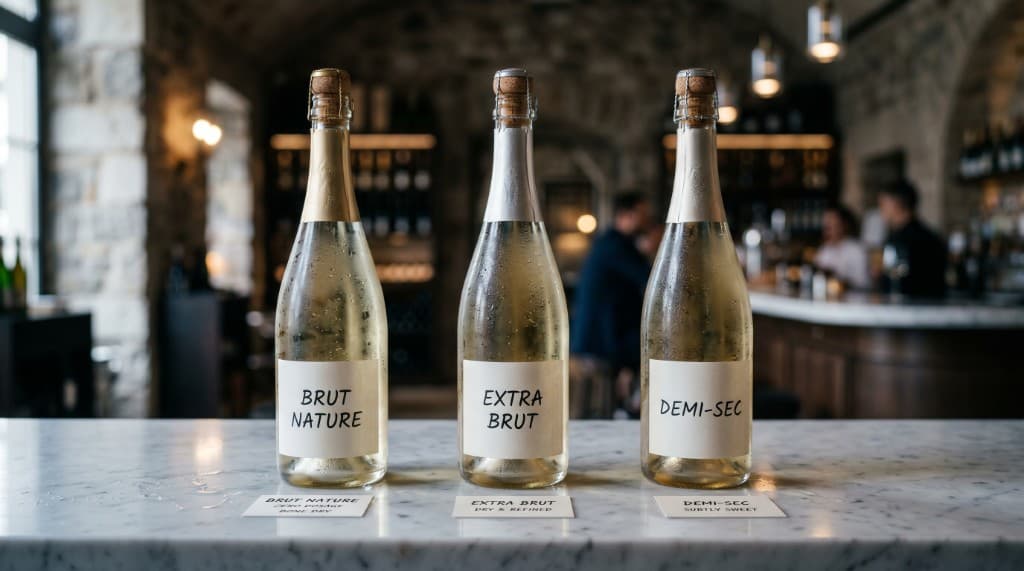
Brut, Extra Brut, Demi-Sec: understanding champagne dosage
The dosage, the small addition of sugar that finishes every bottle of champagne, is the least visible and most misunderstood factor in the price. Here is how to read it and use it to buy smarter.