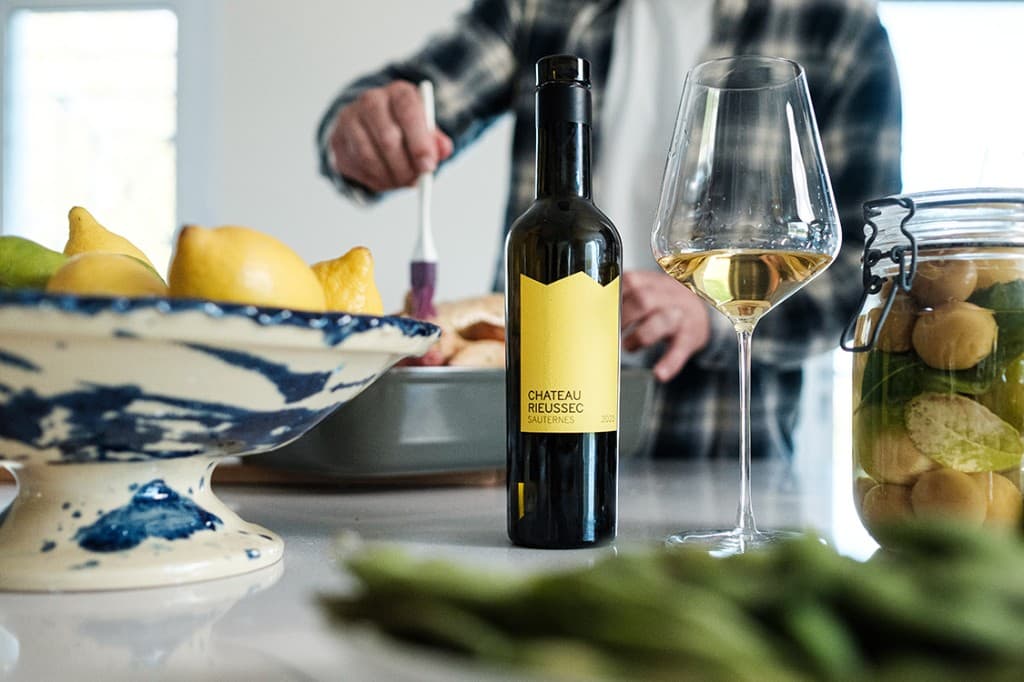
Château Rieussec: how a pricing mistake almost derailed a Sauternes first growth
In 2019, Rieussec was released at €133 a bottle with a new flask design. The market didn’t follow. Since then, the estate has lowered the price with every vintage. The 2024, at €81.60, is back to early-2000s levels. A look at a strategic mistake, its correction, and why this first growth remains one of Sauternes’ best values.
Château Rieussec has been a classified first growth in Sauternes since 1855, owned by Domaines Barons de Rothschild (Lafite) since 1984. Its 85-hectare vineyard sits at the junction of Fargues and Sauternes, on sandy-clay gravel, a few hundred metres from Yquem. For decades it offered one of the best value propositions in the appellation: a classified first growth at an accessible price, carried by Ciron-driven botrytis and reliable consistency. Then came the 2019 vintage.
€133 a bottle and a new silhouette
The 2019 vintage of Rieussec was released en primeur at €133 per bottle. For context: the 2013 sold for €70, the 2011 for €75, the 2010 for €77. Within a few years the price had almost doubled. At the same time, the estate changed the bottle design: the traditional Bordeaux flask gave way to a polarising shape that the market promptly nicknamed "the cup-and-ball".
The strategy was clear: reposition Rieussec as a prestige wine, with packaging to match and a price to anchor it in a higher bracket. The problem is that the Sauternes market is not the same as the Left Bank red market. The traditional clientele, who valued Rieussec precisely for its value, did not follow. Buyers willing to spend €133 on Sauternes turned to Yquem. The in-between positioning did not work: too expensive for loyalists, not mythical enough for collectors.
Six vintages to come back down to earth
What followed is a textbook case of strategic correction in wine. Starting with the 2020 vintage, the price dropped. And it dropped with every vintage, without exception.
Château Rieussec price history (bottle, France, incl. tax)
| Vintage | Unit price incl. tax |
|---|---|
| 2002 | €45 |
| 2005 | €80 |
| 2008 | €55 |
| 2010 | €77 |
| 2011 | €75 |
| 2013 | €70 |
| 2019 | €133 |
| 2020 | €110 |
| 2021 | €105 |
| 2022 | €96 |
| 2023 | €84 |
| 2024 | €81.60 |
The table speaks for itself. Between the 2019 and 2024 vintages, Rieussec lost €51.40 per bottle, a 39% drop. The 2024, at €81.60, is back to the level of the 2005 (€80). In seven years the estate erased twenty years of inflation.
The question is whether this was a deliberate reconquest strategy or a forced adaptation to unsold stock. Probably a mix of both. Sauternes inventory is inherently difficult to shift when prices exceed the market’s psychological threshold. But the regularity of the decline, vintage after vintage, suggests a conscious management decision: return to a price that makes sense for the category.
The real question: Rieussec versus Yquem
Château Rieussec and Château d’Yquem are neighbours. Their vineyards adjoin each other on the left bank of the Garonne, in the zone of influence of the Ciron river, which provides the humidity needed for botrytis cinerea. Both estates share the same dominant grape (Sémillon), the same climate and the same soil types. The classification gap (Premier Cru Supérieur for Yquem, Premier Cru Classé for Rieussec) reflects a hierarchy of means and rigour, not a terroir chasm.
A 2024 Yquem trades at roughly €350 to €400. Rieussec is released at €81.60. The ratio is about four to one. What that premium pays for at Yquem is a stricter selection (more picking passes, even lower yields), longer barrel ageing in new oak, and a heritage stock management that has no equivalent in the appellation. Those resources produce a wine of greater concentration and longevity.
But at a quarter of the price, Rieussec remains a classified 1855 first growth, vinified plot by plot, aged eighteen months in barrels, from a vineyard that borders the greatest sweet wine in the world. For anyone seeking top-tier Sauternes without Yquem’s price tag, it is one of the strongest choices available. And with the 2024 back below €82, the argument is hard to dispute.
The 2024 vintage: technical data and tasting
The 2024 vintage was shaped by a very rainy winter (over 600 mm of rainfall) and mild temperatures. Mildew pressure was heavy, particularly on the Sauvignon. Unusually, the botrytis harvest began much earlier than expected, coinciding with some of the dry whites: a first at Rieussec, which kept the cellar teams on their toes.
Grapes are hand-picked in small crates, pressed in small pneumatic presses, then barrel-fermented (new oak for Sémillon, one-wine barrels for Sauvignon). Each plot is vinified separately. After fermentation the wines rest on their lees with regular stirring, then are blended and aged for around eighteen months in barrels.
Château Rieussec 2024: technical data
| Parameter | Value |
|---|---|
| Appellation | AOC Sauternes |
| Classification | 1855 First Growth (Premier Cru Classé) |
| Blend | 83% Sémillon, 17% Sauvignon Blanc |
| Alcohol | 13.5% vol. |
| Residual sugar | 140 g/L |
| pH | 3.88 |
| Total acidity | 3.81 g/L |
| Ageing | ~18 months in barrels |
| Owner | Domaines Barons de Rothschild (Lafite) |
On the nose, the 2024 opens gradually onto ripe fruit aromas, like candied apricot, with an airy dimension. On the palate, balance is the keyword: a controlled sweetness, a lively thread and an almost saline freshness that stretches the wine with precision. The profile delivers a more chiselled reading of Rieussec, driven by the finesse of the liqueur rather than power.
Frequently asked questions
- Is Château Rieussec a classified first growth?
- Yes. Château Rieussec is classified as a Premier Cru (First Growth) in the 1855 Classification of Sauternes and Barsac. Only Château d’Yquem ranks above it, as Premier Cru Supérieur. Rieussec has been owned by Domaines Barons de Rothschild (Lafite) since 1984.
- Why has the price of Rieussec fluctuated so much?
- The 2019 vintage marked a sharp pricing break, jumping from roughly €70–77 (2010–2013 vintages) to €133. This repositioning, accompanied by a bottle redesign, was not followed by the market. Since then, the estate has lowered the price with each vintage: €110 for the 2020, then €105, €96, €84, and €81.60 for the 2024, returning to early-2000s levels.
- How does Rieussec compare to Yquem?
- The two vineyards are neighbours on the left bank of the Garonne in Sauternes. They share the same dominant grape (Sémillon), the same botrytis cinerea and comparable soils. Yquem, the only Premier Cru Supérieur, benefits from greater resources (stricter selection, longer ageing). A 2024 Yquem trades at €350–400, versus €81.60 for Rieussec: a ratio of roughly four to one.
- How long can Château Rieussec be aged?
- Great vintages of Rieussec can age comfortably for twenty to thirty years or more. Classified Sauternes first growths are among the most age-worthy wines in the world thanks to the balance of residual sugar, acidity and botrytis concentration. Store between 10 and 14°C, away from light, on its side.
- How should a Sauternes like Rieussec be served?
- Serve between 8 and 12°C. Too cold and the wine closes down, with sugar dominating. The classic pairing is foie gras, but Rieussec also works with blue cheeses (Roquefort), stone-fruit desserts, and certain spicy Asian dishes where the wine’s sweetness counterbalances the heat.
- What is noble rot (botrytis cinerea)?
- Botrytis cinerea is a fungus that, in the very specific climatic conditions of Sauternes (morning fog from the Ciron river followed by afternoon sun), develops on ripe grapes in a beneficial form called noble rot. It concentrates sugars and aromas by dehydrating the berries, while imparting characteristic notes (honey, apricot, saffron). It is the factor that distinguishes Sauternes from other sweet wines.
More guides
Bordeaux 2025 en primeur: why this is the buy of the decade
Exceptional quality, the smallest harvest since 1991, and prices held back by years of difficult sales: Bordeaux 2025 en primeur aligns three fundamentals that rarely converge. Here is why it belongs in your cellar.
Minuty M: the rosé that gets a new skin every year
Every vintage, a different label, a different artist, the same rosé. The Minuty M series is one of the rare annual art commissions in the wine world. Five editions reviewed.
Bordeaux en primeur: every vintage from 2009 to 2025 reviewed
From how the en primeur system works to a detailed review of every vintage from 2025 to 2009: style, quality, drinking window and a buying verdict for each year.